

What are the connections between palm oil and climate?
Palm oil has serious implications for land conversion and take-over from forest cover for its production. Given the rise of processed and packaged foods that require palm oil (~50% of food commodities consist of palm oil – RAN, 2011), production demand has been catalysed dramatically, with a doubling of production between 2001 and 2013 (Vijay, 2016). Subsequently the need for land has also increased. A considerably sad statement in Vijay’s analysis is that ‘there is little “deforestation-free” Palm oil. The real question is when landowners cleared the forests’ (Vijay, 2016). And so, given forests act as a natural carbon sink, this has reduced the amount of natural sequestration from previous forest cover, as well as of course the GHG emissions from production processes and harmful land clearing practices e.g. slash and burn which are more accessible and low cost to farming smallholders (Proforest). Holistically, deforestation is contribution ~10% anthropogenic GHG emissions annually (Vijay, 2016).
What are the connections between palm oil and biodiversity?
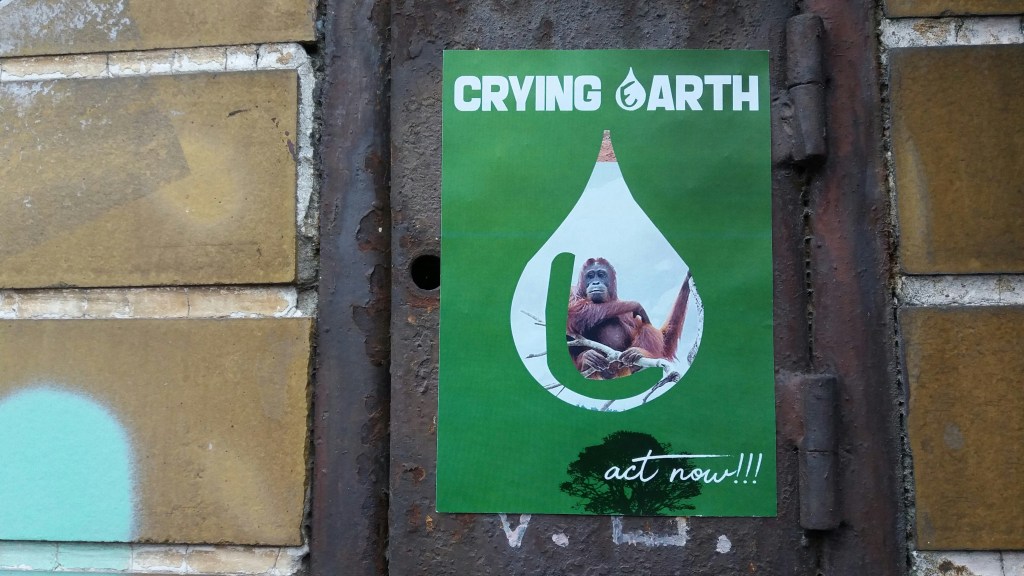
Agricultural land take over is the leading threat to biodiversity currently (Ghadiri, 2024), particularly for vulnerable forests which, by definition, are without IUCN I and II protection. Species that are most threatened are those with small ranges or classified as threatened by the IUCN.
Due to this land use and the homogenous farming practices of palm oil (land clearing practices as aforementioned) as well as the harmful polluting chemicals leached into the environment (Palm Oil Mill Effluent, or POME), this negatively impacts biodiversity, with animals affected either 1) directly (unsustainable habitat available for them, which in itself causes increased human-animal conflicts or, if polluted, impacted ecosystem behaviours) or indirectly 2) soil degradation reduces plant diversity which means limited food sources for animals in these areas.

Which places and people are most affected?
From Vijay’s(2016) analysis across the global sample, deforestation rate is considerably higher in Southeast Asia (where 45% of sampled palm oil plantations came from areas that were forests in 1989) and South America (31%). Much lower was Mesoamerica and Africa (2% and 7% respectively) however suggesting these areas are more vulnerable to deforestation in future given projected increased palm oil production, and we must note here that satellite land imagery is only traced back to 1989, so there is a possibility for greater land take over than the findings suggest.
To what extent do you think the public is aware of these impacts?
In short, a long way from where it needs to be to demand a sea change from the food system of actors in the production, processing and distribution of palm oil. From our current readings across this module I’m finding that such foods palm oil is used for is particularly towards food commodities with reduced nutritional output. In other words, palm oil is one example of a series of food systems that are requiring more and more input, but less and less nutritional output if they were to be measured in mean calorie output or protein output. This of course represents a system orienting itself towards atrophy (aka unsustainable!).
One hope is the Roundtable on Sustainable Palm Oil (RSPO) which currently represents 21% of global palm oil production (Vijay, 2016) and the purpose of this institutional structure being to monitor and responsibly govern with targets, including management, conservation of natural resources and the execution of social and environmental impact assessments. However, given the increasing scarcity of forest cover globally, and the fact that palm oil eligible land tends to be in species dense locations, 21% is grossly under the figure needed in order to effectively govern global palm oil trade. Therefore, my argument is that, with education, consumer pressures can have a positive influence over increasing this figure, given its evident governmental action in the space of biodiversity generally is lacking due to inability to properly identify externalities nor have adequate resources dedicated to modelling the huge economic impacts the biodiversity threat poses (Chatham House, 2022)
What would interventions look like to address these impacts?
From readings so far it seems as though the below 3 seem most impactful:
- Consumption changes – Shifting to alternative food commodities that do not tend to contain palm oil. This also ties in with the climate-biodiversity-health (CBH) nexus that Newell proposes (Ghadiri, 2024) given this nutritional choice shift represents higher quality food sources for the anthropocene. This is almost an essential point given projected population increases and rising living standards globally indicating that, without concerted effort, demand for such palm oil foods will increase.
- Increased governmental regulation, sustainable palm oil policies and enforcement of protected areas against palm oil land use. Nations must protect their carbon sinks, and this is where, in my opinion, the biodiversity credit market represents hope, given the incentivisation of shifting consumption of land activity to protection of it must inherently be a financial one. That government provision of resources, both financial and educational, to palm oil smallholders, should reduce harmful land clearing activity, pollution and unabated deforestation.
- (Footnote on this one as a warning) our previous readings on intensive sustainability, or rather ‘market led’ approaches that essentially suggests generating a network of large-scale farmers/ processors is the answer as it increases governance and monitoring abilities. This represents a widening of social injustices through focusing on environmental impacts, which should not be a trade-off taken lightly.
- Voluntary governance of food system actors. Not only should this be deemed the ‘right’ thing to do by these actors, it represents a long-term sustainable approach to their business model continuing into the future. Given palm oil agriculture is both a cause and effect of climate change, with limited interventions from palm oil trade actors this seriously heightens risks for them in the future. The RSPO is a good start, and will hopefully act as a chain reaction across the piece to a transparent, non-blame culture that focuses on sharing knowledge and acting as a structure of positive accountability.
Sources:
- Vijay, V., S.L. Pimm, C.N. Jenkins, and S.J. Smith ‘The impacts of oil palm on recent deforestation and biodiversity loss’, PloS one 11(7) 2016, e0159668.
- ‘Aligning food systems with climate and biodiversity targets’, Chatham House, (2022). Available here
Ghadiri, M., ‘Applying a climate-biodiversity-health framework to support integrated food systems planning and policy’ Journal of Environmental Management, (2024) Available here. - Proforest, ‘Understand the Supply Chain: Main Environmental and Social Risks Understanding the palm oil supply chain and the environmental and social risks at production level.’, The Palm Oil Toolkit. Available here.
- ‘How to Drive Change Through the Palm Oil Supply Chain’, Rainforest Action Network (RAN) Available here.
- Engage the chain ‘Palm oil’ (n.d.).
 The Colour Green
Leave a comment